




Canton Fair Phase 2: A Project Sourcing Plan for Whole-Home Buyers
Phase 2 of the 140th Canton Fair (Oct 23–27, 2026) covers building materials, sanitary ware and furniture. Plan the five days from your BOQ — and meet George Group at the fair or online.

Ivana Li
George Group · Senior Sales Director
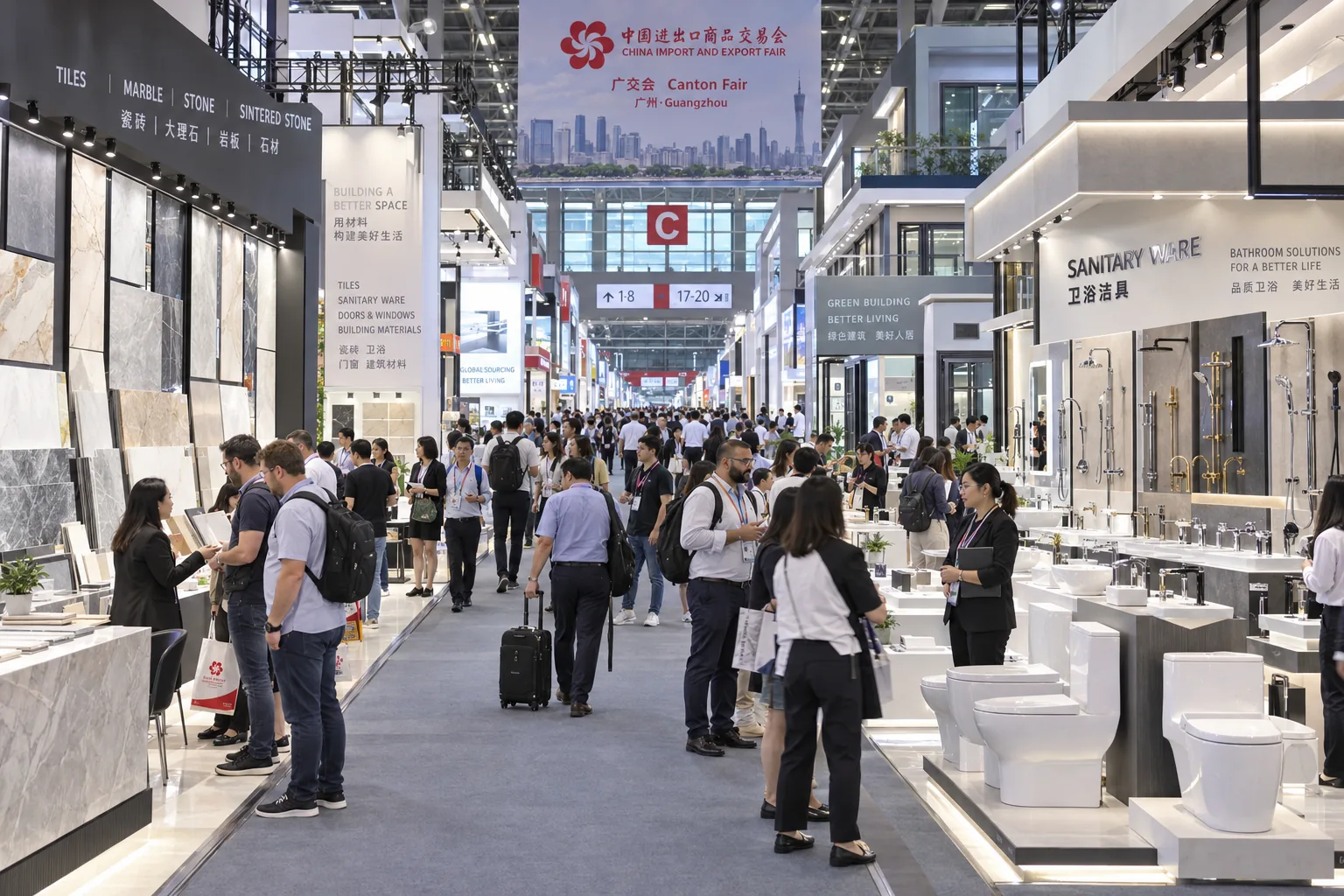
If you are furnishing a hotel, a villa development or a multi-unit project, the five days that matter at the 140th Canton Fair are Phase 2: October 23–27, 2026, at the Canton Fair Complex in Pazhou, Guangzhou. Building and decorative materials, sanitary and bathroom equipment, and furniture all exhibit in these five days — the categories a whole-home project buys together. This guide plans those days the way a project buyer should: from your bill of quantities outward, not from the hall map inward.
One thing up front, because it changes how you read the rest: George Group exhibits in Phase 2 ourselves, so you can meet our team and see samples from every category at the fair. But the fair is a shortcut, not a requirement — if you are not coming to Guangzhou this October, or you are reading this after the fair closes, you can start the same process today from your desk: send your drawings or BOQ, and our design team returns an itemised quotation and a production schedule. Both routes are covered below.
Key takeaways
- Phase 2 (October 23–27, 2026) is where building materials, sanitary ware and furniture exhibit; lighting sits in Phase 1 — plan the five days from your BOQ, not from the hall map.
- You can meet George Group at our Phase 2 booth — but attending is optional: the same one-stop process (design, quotation and production across every category) starts remotely with a drawing set or BOQ.
- A project order is won or lost on comparability and consolidation: identical spec sheets for every supplier, Incoterms pinned on every quote, and one container on one schedule instead of five partial shipments.
What Phase 2 covers — and what it does not
The Canton Fair is not one event but three consecutive five-day phases, each with its own product groups. For the 140th session (Autumn 2026): Phase 1, October 15–19 — electronics and appliances, machinery, hardware, lighting equipment; Phase 2, October 23–27 — building and decorative materials, sanitary and bathroom equipment, furniture, housewares, gifts and decorations; Phase 3, October 31–November 4 — textiles, office supplies, food and personal care. Dates and product groups follow the official session schedule at cantonfair.org.cn — re-verify before booking travel, as session details can be updated.
Mapped to a whole-home BOQ: tiles, stone, doors and windows, and sanitary ware sit in the building and decorative materials halls; furniture has its own halls across the complex. One honest caveat — lighting exhibits in Phase 1, which ends four days before Phase 2 opens, so buyers who need both either plan a longer trip or handle lighting separately. Our clients usually handle it through us: one supplier quoting it alongside everything else.
Two administrative notes before the strategy. Overseas buyers register for a free Buyer Badge through the fair's official Buyer Service System, which also issues the invitation letter used for visa applications — do this weeks ahead, not at the door. And if your BOQ spans several of these categories, that multi-category brief is exactly what our design team works from every day — you can send it before you book a flight.
Five days, routed by project type
What you are building decides where your hours go. Villa and residential developers: finishes drive your project, so split days between the materials halls (tiles, stone, sanitary ware) and the furniture halls — your buyers will see both in the same rooms. Hotel and resort projects: start in furniture — room packages are your longest-lead, highest-value category — then sanitary ware and materials. Importers and contractors buying for multiple units: materials halls first for the volume categories, furniture second, and use day five to lock appointments, not to browse.
Whatever the project type, the rhythm that works is the same: days one and two for a first pass through your priority halls, day three for the secondary categories, and days four and five reserved for second visits — going back to the two or three suppliers per category who survived the first pass, collecting firm quotations against your spec sheet, and confirming what happens after the fair. Five days collecting catalogues produces a suitcase; two days of follow-up produces a supply chain.
Meet George Group at Phase 2 — or start from your desk
George Group exhibits in Phase 2, and fair week is the easiest time to meet us. At our booth you can handle samples from across our categories, hand our team your BOQ or drawings, and leave with an itemised quotation in progress — plus a showroom appointment for the days after the fair, when the real decisions happen. Message us on WhatsApp before you fly and we will send you the hall and booth number and reserve a meeting slot with an English-speaking project coordinator. Fair week fills up fast, so the earlier you book, the more of our team you see.
Not coming to Guangzhou — or reading this after the fair has closed? You lose nothing essential. Most of our projects start remotely: you send the drawings, BOQ or a designer's spec book; our design team returns space planning, 3D references and an itemised quotation; physical samples — fabric swatches, finish panels, hardware — courier to you before anything enters production. The fair compresses introductions into five days, but the process underneath it runs all year.
Who you would be working with either way: George Group is a factory group founded in Foshan in 2006 — twenty years of export experience, 10,000+ projects delivered across 50+ countries, and a 30,000 m² showroom about an hour from the fairgrounds. We design and manufacture across every whole-home category — kitchen cabinets, wardrobes, doors and windows, stone, tiles, bathrooms, lighting and furniture — which means a project buys once, from one group, at factory-direct prices, instead of assembling five supply chains across three cities. That is what one-stop means in practice: one design team, one production schedule, one container, one point of accountability.
Build your fair route from the BOQ
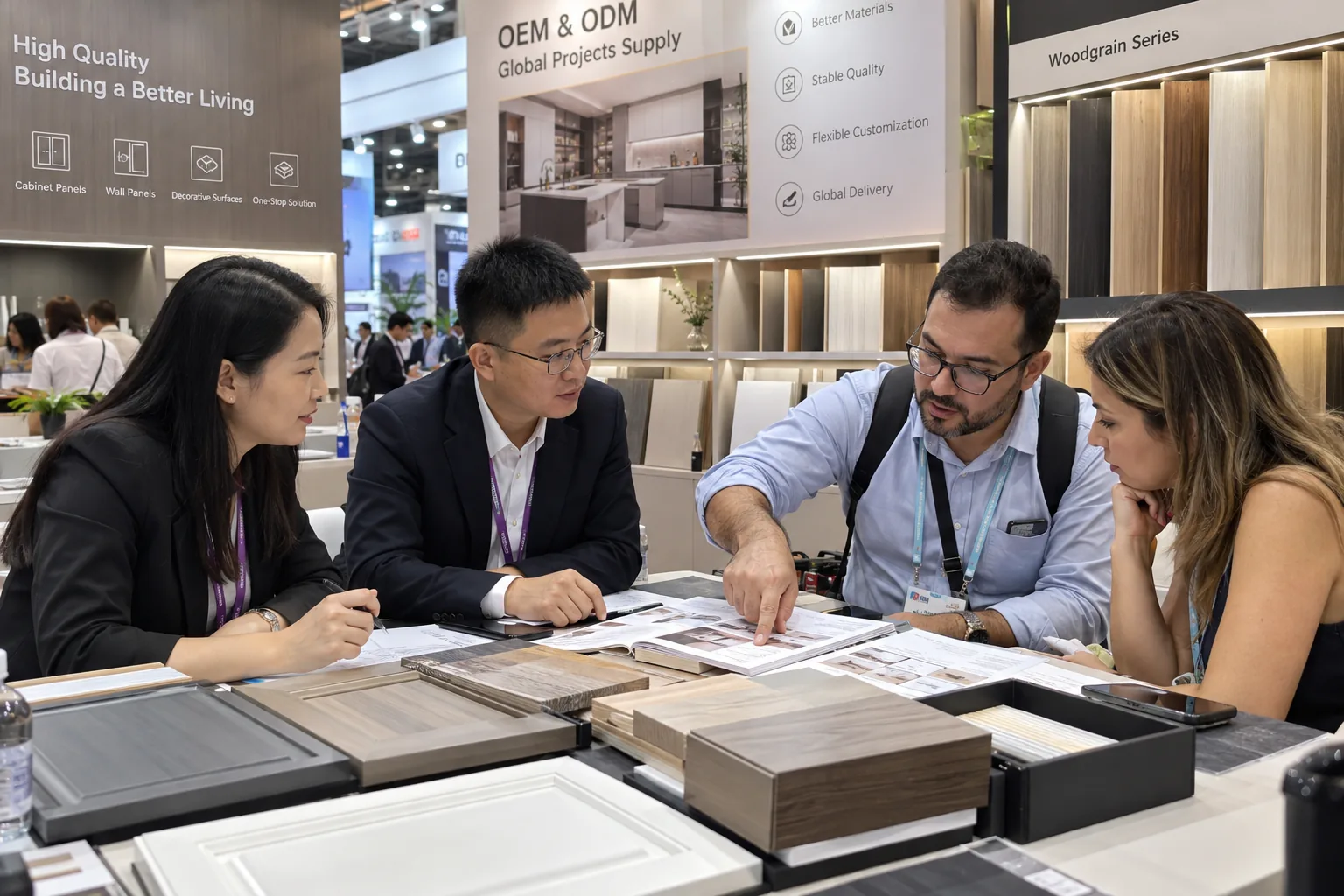
The hall map organises suppliers; your BOQ organises decisions. Before you land, map every BOQ line to two things: what you will physically compare at the booth, and the one question that separates a real manufacturer from a reseller. This is the grid we hand to visiting buyers:
| BOQ line | What to compare at the booth | The question that matters |
|---|---|---|
| Kitchen cabinets & wardrobes | Carcass materials, edge banding quality, hardware tiers (hinges, runners), finish samples | "Can you build to my drawings and room dimensions — not just your catalogue sizes?" |
| Doors & windows | Profile series, glass specifications, hardware, thermal and acoustic ratings | "Which test reports cover my market — and are they for this exact profile?" |
| Bathroom & sanitary ware | Ceramic quality, flushing mechanisms, faucet plating, vanity construction | "Which certifications do you hold for my destination — cUPC, WRAS, CE, SASO?" |
| Tiles & stone | Calibre and shade consistency across boxes, slab vs tile formats, anti-slip ratings | "Can you guarantee one production batch for my whole quantity?" |
| Furniture | Frame materials, foam density, upholstery grades, joinery on case goods | "Can you produce to my room schedule, in my finishes, on one shipping date?" |
| Lighting (Phase 1) | Driver quality, colour temperature consistency, dimming compatibility, certifications | "Will your fixtures pass my market's electrical compliance — and who tests them?" |
The rows share one discipline: bring one identical spec sheet per category — sizes, materials, hardware tiers, finishes, certification targets — and hand the same sheet to every supplier you talk to. Quotes are only comparable when they price the same thing. And note how category-specific the details get: a spec sheet for doors and windows needs profile series and glass specifications, not just opening sizes; a tile sheet needs calibre and shade tolerance, not just square metres. If a supplier quotes carefully against your sheet, that tells you something about how they will handle your order.
Where project buyers get burned at the fair
Most expensive mistakes at the Canton Fair are not about picking the wrong supplier — they are about leaving with numbers and impressions that cannot survive contact with a contract. The five we see most often:
1. Comparing quotes built on different terms. An EXW price, an FOB price and a CIF price are three different offers for the same product. Pin the Incoterm on every quote, ask what payment terms sit behind it (a 30% deposit with the balance against pre-shipment evidence is the structure you should expect), and remember that freight-heavy terms like CIF and DDP are estimates until the final packing list fixes the real volume and weight.
2. Judging production quality by booth samples. Everything at a fair is staged — the best pieces, the best finishes. Production capacity and quality control can only be verified on a factory floor, by your own visit or by third-party inspection ($150–$350 per inspector-day with SGS, Bureau Veritas or TÜV — cheap insurance against a container's value).
3. Category lead times that ignore each other. Tiles may run twenty days while custom kitchen cabinets run forty-five. If every supplier ships on its own clock, your container either waits on the slowest category or sails half-full — and at current freight rates, a half-empty 40ft container is the most expensive line on your spreadsheet. Ask every supplier one question: can you hold your category for a consolidated shipment date?
4. Per-category MOQs that punish mixed orders. A booth MOQ assumes you are buying that category alone. Project buyers should ask for the mixed-container policy explicitly — many factories relax per-item minimums when categories ship together.
5. Leaving China without a next step. Every supplier who survives your shortlist should exit the fair holding three things: your spec sheet, a deadline for the itemised quotation, and a confirmed factory or showroom appointment. A handshake and a WeChat contact is not a next step.
After the fair: one quotation, one container, one schedule
Phase 2 closes on October 27. The order starts after. Book October 28–29 in Foshan — about an hour from the fairgrounds — while booth conversations are still fresh. At our showroom, 30,000 m² across nine floors, you walk every category side by side at full size: cabinet series, window and door systems, bathroom fixtures, tile and stone selections, lighting and furniture. What the fair compresses into samples, the showroom shows as complete rooms — and your quotation gets finalised against what you actually saw.
Then the economics of consolidation take over. One production schedule across all categories, one consolidated container with a room-by-room packing list, one document set. Freight alone makes the case: as of October 2026, a 40ft container runs roughly $3,400 to Northern Europe and over $7,700 to the US West Coast — one well-planned container instead of two half-empty ones is worth more than most price negotiations. We quote in USD, itemised line by line, so you can compare our landed cost against any other offer you collected at the fair.
For the procurement model behind this — what a whole-home package covers, where duties and compliance change the maths by destination, and how production and inspection run step by step — see our FF&E procurement guide. It is the year-round version of everything this article compresses into fair week.
Phase 2 checklist for project buyers
Whether you meet us at the fair or start remotely, have these ready before you request any quotation:
1. Your BOQ with quantities — rooms × items × units is the minimum viable brief.
2. One spec sheet per category — sizes, materials, hardware tiers, finishes, and the certifications your market requires (TSCA Title VI for US composite wood, WRAS or cUPC where they apply, SASO/SABER for Saudi Arabia).
3. Buyer Badge registration done weeks ahead — the invitation letter for your visa comes from the same system.
4. A landed-cost benchmark per category, so every booth quote can be judged in seconds instead of believed.
5. Meeting slots booked before you fly — including ours: WhatsApp us your dates and we will reserve time with an English-speaking coordinator and send you the booth details.
6. An exit criterion for every shortlisted supplier: spec sheet handed over, quotation deadline agreed, factory or showroom appointment confirmed.
7. October 28–29 reserved in Foshan — the two days where the fair turns into an order.
Coming to Phase 2? Send your dates and your BOQ — we will hold a meeting slot at our booth and have a first quotation in progress when you arrive. Not coming? The same process starts from your inbox:
Questions importers ask us first
Straight answers on minimum orders, lead times, shipping and payment — before you commit.
Ivana Li
Senior Sales Director
Ten years focused on the global furniture and building-materials market, with deep project experience — you speak to her directly on WhatsApp.
Replies within one working day
Still have a question?
Send your list and get a costed, itemised answer — no obligation, no sales pressure.
Which Canton Fair phase has building materials, sanitary ware and furniture?
Phase 2 — October 23–27, 2026 for the 140th autumn session — covers building and decorative materials, sanitary and bathroom equipment, furniture, housewares, and gifts and decorations. Lighting exhibits in Phase 1 (October 15–19), which ends before Phase 2 opens, so plan lighting separately or source it through a supplier who carries all categories. Always re-verify against the official schedule at cantonfair.org.cn before booking travel.
Where is George Group's booth at the fair?
We exhibit in Phase 2 (October 23–27, 2026). Message us on WhatsApp with your dates and we will send you the exact hall and booth number and reserve a meeting slot with an English-speaking project coordinator — fair week fills up quickly, so booking before you fly is strongly recommended.
Can I source a whole project at the fair without visiting any factories?
You can shortlist at the fair, but serious project orders should close only after capacity and quality control are verified — at a showroom or factory visit, or through third-party inspection. The fair is the comparison stage, not the verification stage.
I'm not travelling to China this year. Can I still work with George Group?
Yes — most of our projects start remotely. Send your drawings, BOQ or spec book and our design team returns space planning, 3D references and an itemised quotation; physical samples are couriered to you before production, and production is documented with photo and video records through pre-shipment inspection. The fair is a shortcut to meeting us, not a requirement.
How should I compare quotations from different suppliers at the fair?
Hand every supplier the identical spec sheet per category, pin the Incoterm (EXW, FOB and CIF are not the same offer), keep everything in one currency — we quote in USD — and check the payment structure behind each price: a 30% deposit with the balance due against pre-shipment inspection evidence is what a serious factory offers.
What is the minimum order for a mixed-container project?
There is no fixed per-item MOQ when categories ship together in a consolidated container. Multi-room and multi-unit projects — a hotel floor, a serviced-apartment block, a villa development — are where the economics work best.
How long does production take after the fair?
Typical production runs 35–55 days depending on categories and finishes, plus sea freight to your port. Your coordinator confirms a written per-project schedule before you pay any deposit — and when all categories come from one group, they run on one schedule against a single shipping date.